
 Italiano




Airsoft Batteries: Complete Guide to Li-Ion, LiPo, LiFe & Ni-MH | Which One to Choose?
- 23 Jan, 2026
- Home , Airsoft Batteries & Power
- 0 Comments
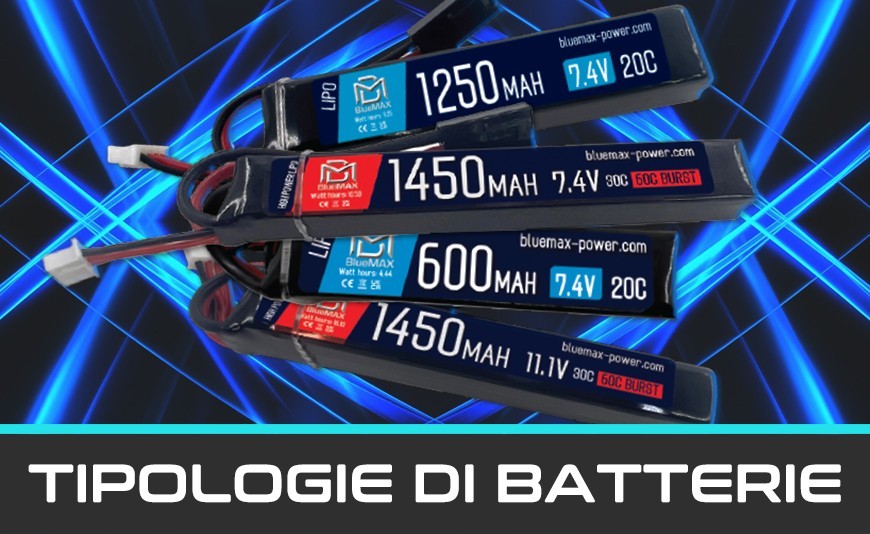
Batteries are among the most critical components for the performance of an electric replica.
It’s not just about autonomy: voltage, cell type, and capacity influence trigger response, ROF, and reliability.
This guide helps you correctly choose between the main categories: Li-Ion, LiPo, and LiFe.
Why the battery is essential
The battery is not just a power source: it determines how the replica responds to the trigger.
Performance aspects that depend on the battery:
- Trigger response: how quickly the trigger reacts
- ROF (Rate of Fire): how many shots per second
- Mechanical stress
- Overall autonomy: how long it lasts before needing replacement in the field
A poorly chosen battery causes:
- power drops
- slow response
- overheating
- premature motor wear
So yes: choosing the right battery changes your shooting experience.
Battery types considered
In this article we analyze:
- Li-Ion (Lithium-Ion)
- LiPo (Lithium Polymer)
- LiFe (Lithium Iron Phosphate)
All are lithium-based batteries, but with different voltage characteristics, management requirements, and behavior.
- Batteries Ni-MH (Nickel-Metal Hydride)
Ni-MH batteries are the “traditional” technology used in airsoft before the spread of lithium batteries.
1) Li-Ion Batteries
What they are
Li-Ion batteries are based on cylindrical or prismatic cells similar to those used in smartphones or laptops.
They provide a more gradual and stable discharge, making them particularly suitable for long games. They ensure excellent autonomy and are less prone to swelling compared to LiPo batteries when used correctly.
In airsoft, they are ideal for balanced setups or mainly semi-auto use, such as light DMR builds.
Pros ✔
- Good energy density (high autonomy)
- Gradual discharge curve
- Stable and long-lasting
Cons ✖
- Less responsive than LiPo
- Lower peak power
When to use them
Ideal for those looking for:
- high autonomy
- balanced performance
- extended use without compromising longevity
2) LiPo Batteries
What they are
LiPo batteries feature flat cells, lightweight construction, and high discharge capability.
Today they are the main choice for high-performance setups. They deliver current very quickly, resulting in immediate trigger response and high ROF.
They are particularly recommended for replicas equipped with MOSFETs or advanced electronics and for high torque or high speed motors. The wide availability of formats (stick, nunchuck, buffer tube, slim) makes them extremely versatile even in tight spaces.
Pros ✔
- Very high responsiveness
- Excellent peak power
- Perfect for replicas with MOSFET
Cons ✖
- More delicate if poorly managed
- Require a balanced charger
- Sensitive to deep discharge
When to use them
Perfect for:
- replicas with MOSFET
- those seeking high ROF
- performance-oriented setups
Important: Use a balanced charger, pay attention to minimum discharge levels, and store at storage voltage when not in use.
3) LiFe Batteries (LiFePO₄)
What they are
LiFe batteries use lithium iron phosphate chemistry, which is more stable than Li-Ion and safer than LiPo.
They are chemically more stable than LiPo and more predictable even with temperature variations. They provide good performance while keeping mechanical stress contained, making them suitable for those who want a safe upgrade without pushing the replica to extreme levels.
Pros ✔
- Extremely stable
- High cycle lifespan
- Superior safety
- Very linear discharge voltage
Cons ✖
- Lower nominal voltage (3.2 V per cell)
- Lower peak power than LiPo
When to use them
Excellent if:
- reliability and safety are the priority
- you want to minimize stress on motor and gears
- you play in fields with variable temperatures
4) Ni-MH Batteries
What they are
Ni-MH batteries are the most traditional technology. They are robust, tolerant, and do not require balancing during charging.
However, they are bulkier, less responsive, and have lower energy density compared to lithium batteries. A 9.6V Ni-MH, while more responsive than an 8.4V, does not offer the same performance as a quality 7.4V LiPo.
Pros ✔
- Very robust and error-tolerant
- Less sensitive to over-discharge compared to LiPo
- No balancing required
- Generally more affordable
Cons ✖
- Greater weight and size
- Lower energy density
- Memory effect (if not properly managed)
- Less reactive current delivery compared to LiPo
When to use them
They are suitable for:
- entry-level replicas
- those looking for ease of use
- beginner players
- those who do not want to manage more complex charging protocols
Voltage: what changes
Voltage is what “drives” the motor: more voltage = more RPM = higher rate of fire.
Common voltages
- 7.4 V
- - Excellent balance of power and safety
- - Ideal for stock/light upgrade AEGs
- 9.9 V
- - Higher ROF compared to 7.4 V
- - More responsive without extreme stress
- 11.1 V
- - Higher power
- - More stress on gears and motor
mAh: Capacity and duration
mAh do not affect power or ROF, but determine how long the battery lasts before needing to be recharged.
Discharge rate: the “C” value
The C value indicates the battery’s ability to supply current. A formula is used to calculate the maximum deliverable current:
Maximum current = mAh × C / 1000
Example with a 2200mAh battery rated at 20C:
( 2200 x 20 ) / 1000 = 44 A (maximum Amps)
The higher the deliverable current, the more the battery can sustain high ROF without voltage drops.
Which battery should you choose for your replica?
Stock or entry-level replica
For original replicas intended for the Italian market and sold on Softair Games, it is allowed to use exclusively batteries with a voltage equal to or lower than 7.4 volts, in order not to violate the contractual warranty terms.
Even if the manufacturer may indicate compatibility with 11.1V batteries, this specification often refers to foreign markets and not the Italian one.
The use of batteries with voltages higher than 7.4V is allowed only if explicitly stated in the product description published on our Softair Games website. In the absence of such indication in our product sheet, it is necessary to comply with the 7.4V limit to avoid voiding the warranty.
Common mistakes to avoid
❌ Using LiPo without a balanced charger
❌ Choosing based only on mAh
❌ Thinking that more volts = only advantages
❌ Ignoring the C value
❌ Discharging LiPo below the minimum threshold
Safety and maintenance
- Always charge with a balanced charger
- Store LiPo at storage voltage if your charger allows it
- Do not leave batteries charging unattended
- Never bend or puncture the cells
Proper management extends lifespan, performance, and safety.
FAQ – Frequently Asked Questions
- Which battery provides the best trigger response?
- LiPo with adequate voltage and high C rating.
- Do higher volts mean damage to the replica?
- Not always, but without a MOSFET they can stress the motor and contacts.
- Are LiFe better than LiPo?
- It depends: LiFe are more stable and safer, but less powerful than LiPo.
- Is the C rating really important?
- Absolutely yes. It determines how much current the battery can supply without drops.



Leave a Reply Cancel Reply